Imagine being in a small room in a village called Kirikasamma back in 1983. The air is heavy, and all you can hear is the sound of a woman struggling. That woman is Mari, and she is going through the kind of pain that makes a person forget where they are. She never thought having a baby would hurt this much. It is so bad that she can't even finish her prayers. She starts one verse and jumps to another because the pain is just too much to handle. In that moment, she starts thinking about her late mother, Inna. She even starts begging her dead mother to save her. It is really heartbreaking to read because you can feel how scared and alone she feels, even though people are with her.
Her mother-in-law, Inna Mairo, is right there by her side. Mari looks at her with so much pain in her eyes and asks her a question that shows just how much she is suffering. She says, "Do you know the kind of pain I’m feeling, Inna Mairo? Right here... it feels like I’m being split into two." (translated from Hausa). This part really got to me because it shows how raw and real the struggle of motherhood starts. Inna Mairo just gives a small smile because she has been through this thirteen times. She knows exactly what Mari is feeling, but she also knows that this is just the beginning of the journey. If you enjoy stories that show the real life of women in the North, you should definitely check out Taskar Novels for more stories like this.
The scene gets even more intense when the traditional midwife, Harira, comes in. They don't have fancy hospital lights; they are using a torchlight and a small local lamp called an acibalbal. Harira has to use a razor to help the baby come out because things are getting stuck. Mari feels everything. Even though people say women forget the pain of labor, the way Batul Mamman writes this, you feel like Mari will never forget. But then, the moment the baby finally comes out and lets out that first cry, everything changes. The pain just vanishes and is replaced by a deep love. It is like magic. Mari is so happy that she even forgets she was about to curse her husband, Inusa, for putting her through this.
Mari names her son Auwalu, but everyone calls him Abbati. She has so many big dreams for him. She wants him to go to school, to learn both Western and Islamic education, and maybe even become a big doctor or a lawyer. She doesn’t want him to just stay in the village; she wants him to see the world like the people she saw when she was working as a maid in the city. She even promises the tiny baby that she will keep sewing and saving every kobo just to pay for his school. This part is so beautiful because it shows that no matter how poor a mother is, her dreams for her child are always giant. It reminds me of the deep family bonds we see in MATAR HAIDAR, where family is everything.
After the birth, the story shows us the traditional things they do, like the hot water baths. If you know about "wankan jego," you know it is not a joke. They use really hot water and a bunch of herbs to "fix" the body after birth. Mari is screaming because the water is so hot, but the older women tell her she has to do it. They even use a herbal paste that they put on her wounds. It sounds very painful, but after a few days, she starts to heal. It’s a tough life, but these women are even tougher. You can find many stories about these kinds of traditions when you download Hausa novels from the best sites online.
Then the story jumps forward to 1985 in Kano, and we meet another woman named Innayo. Her life is very different but also very hard. She is living in a house with her husband, Alhaji Rabi'u, and another wife named Asabe. Innayo is exhausted. She has five kids of her own, including a tiny baby named Hasiya who won't stop crying at night. But that’s not all—she is also taking care of four other children that belong to a wife who left the husband. So this poor woman is looking after nine children all by herself! This kind of domestic drama is what makes AQIDARMU such a popular read as well.
One night, the baby Hasiya is crying a lot, and Alhaji Rabi'u gets really angry. He doesn't care that Innayo is tired from cooking and cleaning for a huge family all day. He just wants to sleep. He actually kicks her to wake her up! Can you imagine? Then he does something even more shocking. He pulls out some money and tells her that he is "buying" her nights. He says, "I have bought your nights, Innayo! Take your daughter and go back to your room." (translated from Hausa). He basically tells her that he will pay her to stay away from him so he doesn't have to hear the baby cry. He’s supposed to be with her that night, but he’d rather pay her off like a worker than deal with his own child's crying.
Innayo is just standing there in the dark, confused and hurt. She asks him what she did wrong, but he doesn't want to hear it. He just wants her out of his sight. It shows how some men in these stories treat their wives like they are just there to serve and not to be cared for. It’s a very emotional part of the book because you see how much Innayo is carrying on her shoulders. She is the one feeding everyone, the one staying up all night, and yet she gets no respect. This is the kind of stuff that makes you want to keep reading to see if she ever gets a break. For those who like stories with a bit more edge, you might also like DAN DAUDU KO DAN LUWADI Book 1 or even KANWAR MATATA which deal with complicated family lives.
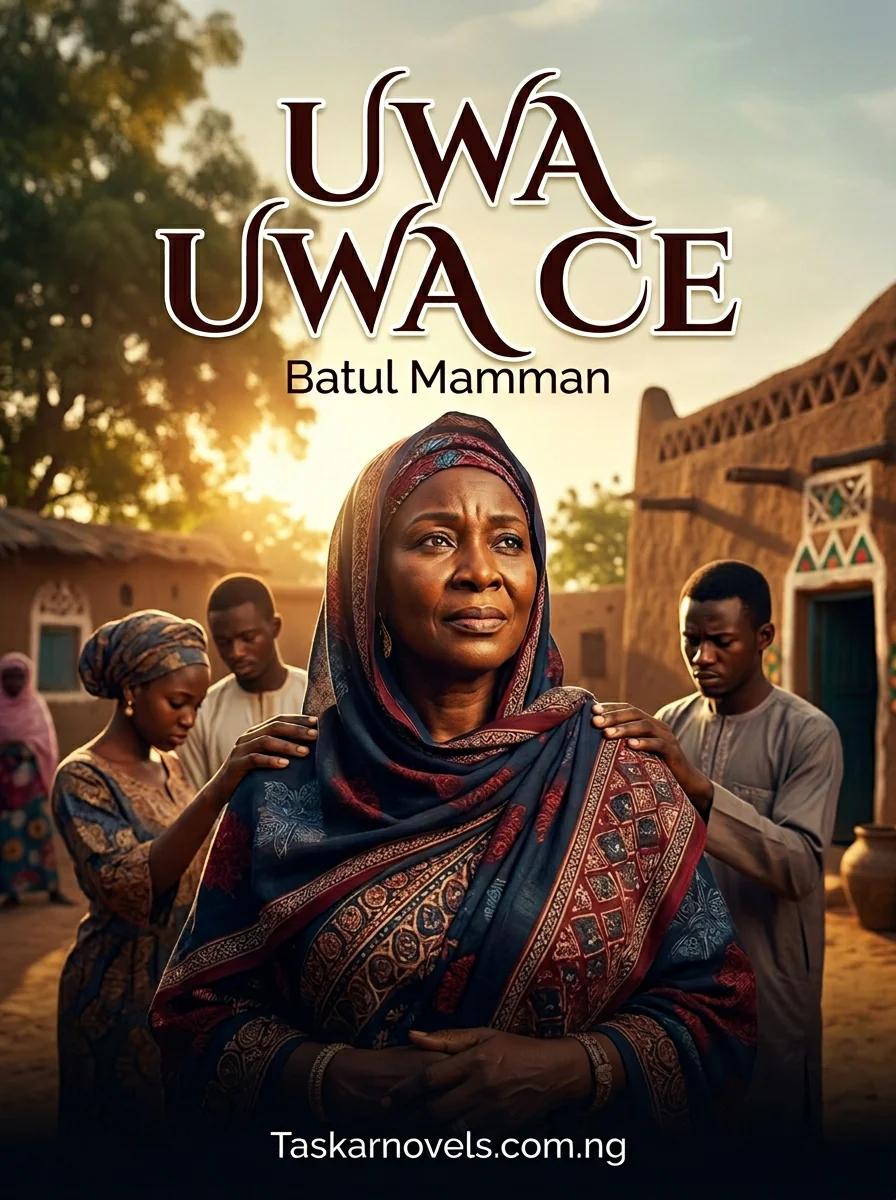
The title "Uwa Uwa Ce" really starts to make sense as you read. It means "A Mother is a Mother," and it focuses on the sacrifices these women make. Whether it is Mari in the village dreaming of a better life for Abbati, or Innayo in the city struggling to raise nine children while her husband ignores her, the central theme is the strength of a mother. They go through the pain of birth, the heat of the baths, the exhaustion of housework, and the emotional pain of being unappreciated, all for their children. If you are looking for Hausa novels online that talk about real life and the struggles of the heart, this one is a great choice.
Batul Mamman really knows how to pull at your heartstrings. She doesn't sugarcoat anything. She shows the dirt, the sweat, the blood, and the tears. But she also shows the smiles and the hope. It makes the characters feel like people you know in real life. You start to worry about what will happen to Abbati when he grows up. Will he fulfill his mother's dreams? And what about Innayo? Will she ever find peace in her husband's house? There is so much drama packed into these pages. It’s definitely one of the best Hausa novels I’ve come across lately because it feels so grounded in our culture.
Sometimes when we read books like SEX BEFORE MARRIAGE or FARASHIN SO by 'kanwar soja, we see different sides of love and relationships. But "Uwa Uwa Ce" focuses on that special kind of love that only a mother has. It is a love that doesn't ask for anything back, even when things are incredibly tough. I spent the whole time reading it wishing I could jump into the book and give Innayo a helping hand with those nine kids! It really makes you appreciate your own mother more after seeing what these women go through.
The way the story moves from the village in 1983 to the city in 1985 shows how things change but also how they stay the same. Mothers are still the ones doing the heavy lifting. The drama between the co-wives, the pressure of raising a family, and the desire for the next generation to have a better life are all there. It’s a beautiful, sad, and hopeful story all wrapped into one. You should definitely find some time to sit down and read the whole thing. You won't regret it at all.
If you want to read the full story of Mari, Innayo, and their children, you can find it and many other amazing books on Taskar Novels. It is the best place to find all your favorites and discover new ones. Just head over to Taskar Novels to get your copy and start reading today!